Five paint colors that make rooms look bigger
November 10, 2021An exterior painting and maintenance checklist for the holiday season
December 6, 2021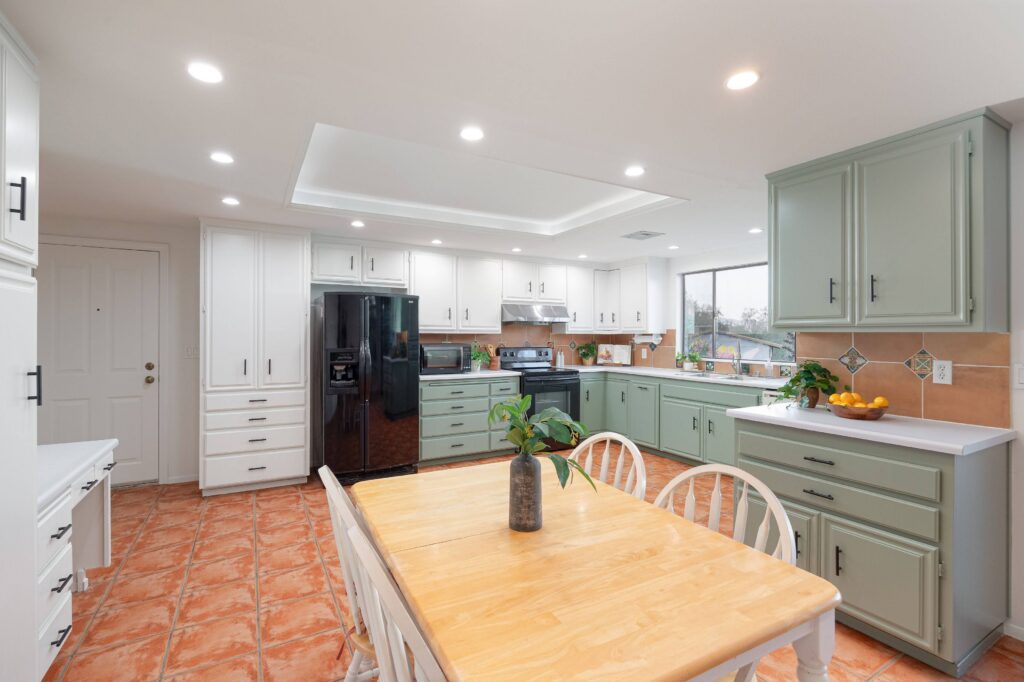
A chip beside a cabinet handle and a door with paint lifting off in sheets are not the same problem. One may be ordinary wear. The other needs an assessment of the finish underneath, not another quick coat of color.
When I talk about cabinet paint failure, I mean peeling or widespread chipping—not every small mark left by a fingernail, a trash can, or a pot hitting a drawer. That distinction matters before you decide whether to touch up a few spots or pay to repaint the kitchen.
Here is how to think through peeling cabinet paint, what preparation should address, and what to ask before hiring someone to fix it.
Is your cabinet paint failing, or just showing normal wear?
Start with where the damage appears and how far it extends. A tiny impact chip where a pan struck a door is different from peeling across several doors that have not been hit. Looking at one close-up without the rest of the kitchen can make either problem look worse—or smaller—than it is.
- Normal wear: isolated dings around pulls, knobs, and door edges, or light scuffs where the trash can rubs. Even a well-painted kitchen can develop these marks.
- A possible coating failure: paint lifting away, broad peeling, or chips appearing across multiple surfaces. The existing coating and its preparation need to be checked.
- A separate repair concern: swollen material, water-damaged edges, or a door that is coming apart. A new finish is not a substitute for repairing the cabinet itself.
These are useful distinctions, not a diagnosis from a photograph. Water damage, for example, does not prove that the painter used the wrong product. The moisture source and the condition of the material both matter.
Why does paint peel off kitchen cabinets?
The surface was not properly cleaned
Cabinets live around cooking grease, hands, and cleaning products. My cabinet preparation starts with degreasing. Sanding is not a substitute for that step, and a premium finish does not make surface contamination irrelevant.
Rust-Oleum’s B-I-N Shellac technical data sheet calls for a clean, dry, sound surface without grease, oil, wax, or other contamination that could interfere with adhesion. It also calls for removing unsound coatings. Those requirements matter just as much when you are repainting an old painted cabinet as when you are changing stained cabinets to a painted finish.
The existing finish and primer were not treated as a system
Many stained cabinets already have a clear finish. In my usual preparation process, we scuff that coating and remove the sanding dust before priming. The purpose is to prepare the existing surface for the next layer, not to make the wood absorb as much paint as possible.
For our cabinet work, I use B-I-N Shellac primer. That does not mean every water-based primer is unsuitable. A general-purpose primer and a product formulated for bonding to difficult surfaces are different things. Sherwin-Williams Extreme Bond Primer, for example, is designed for hard, glossy surfaces.
The useful question is not simply “Was primer used?” It is “Was the primer appropriate for this surface and compatible with the finish?” A product name helps you get a meaningful answer.
The finish was chosen without considering cabinet use
Cabinet doors and drawers get repeated handling. The cabinet finishes I recommend include Sherwin-Williams Gallery Series, Emerald Urethane, and Dunn-Edwards AristoShield. I do not treat ordinary wall paint as interchangeable with a cabinet coating.
But naming a premium product is only part of the answer. The condition of the old coating, preparation, application, and time between stages still matter. The most expensive topcoat cannot make loose paint underneath it sound.
The new coating was used before it was ready
A finish can feel dry before it is ready for normal handling or cleaning. If damage appears soon after painting, the product and its care instructions need to be considered alongside preparation. Our guide to paint drying and curing explains why touch-dry, recoat time, and readiness for use are different milestones.
Can peeling cabinet paint be touched up?
A small, localized impact chip may be a reasonable touch-up candidate when the surrounding finish is sound. Widespread peeling is a different scope. Covering the visible spots without addressing the unstable coating underneath may leave you paying for the same problem again.
Before agreeing to a repair, ask what will be removed, what can remain, and why. If a proposal says only “sand and repaint,” it has not explained how the failed areas will be handled. The estimate should also distinguish coating work from damaged-door or cabinet-material repairs.
Matching a touch-up involves more than knowing the color name. Keep the product, sheen, and color information from the original job if you have it. That gives the painter a better starting point; it is not a promise that every repair will disappear.
For older homes, do not start scraping or sanding old paint to investigate it yourself. The EPA’s lead-safe renovation guidance explains the risk of lead dust when disturbing lead-based paint in pre-1978 homes. Discuss the age of the coating and any necessary assessment before work begins.

Would a sprayed finish prevent peeling?
Spraying is my preference for a factory-like kitchen cabinet appearance. Rolling leaves a texture that some homeowners do not want on highly visible doors. That is an appearance decision, not proof that a sprayed coating automatically lasts longer.
With a coating suitable for both methods, equivalent preparation and the specified film thickness matter more than the application method alone. Some cabinet coatings, such as Gallery Series, are spray-applied; follow the actual product instructions. If paint is peeling because the old surface was unsuitable, changing the application method alone does not answer that problem.
What should a cabinet repainting estimate explain?
Before comparing prices, make sure the proposals describe comparable work. For a peeling kitchen, I would want the following questions answered:
- How will the existing finish be assessed, and which areas need coating removal or material repair?
- What cleaning, surface preparation, primer, and finish are included?
- Are doors and drawer fronts being removed, and how will the surrounding kitchen be protected?
- Which surfaces are included, and what is excluded?
- What instructions will you receive for handling and cleaning the new finish?
For pricing and the broader project sequence, see our San Diego cabinet painting cost and process guide. This article addresses a different decision: whether the existing finish is sound enough for a limited repair or needs a more substantial repainting scope.
Cabinet paint failure FAQ
Does every chip mean the cabinet paint job failed?
No. Small impact chips around handles or door edges can be normal wear. Peeling or widespread chipping across multiple surfaces is a reason to assess the coating system rather than assume a few touch-ups will solve it.
Can you paint directly over peeling cabinet paint?
Loose or unsound coatings need to be addressed before a new finish is applied. The repair scope depends on how much paint is unstable and whether the cabinet material is damaged. A new topcoat alone does not repair the layer beneath it.
Are water-based primers always wrong for cabinets?
No. Some bonding primers are formulated for hard, glossy surfaces. J Brown Painting uses B-I-N Shellac for cabinet preparation, but the broader issue is selecting a compatible primer for the actual surface, not rejecting every water-based product.
Does spraying make cabinets more durable than rolling?
Not automatically. Spraying gives a smoother, factory-like appearance. With a coating suitable for both methods, equivalent preparation and the specified film thickness matter for durability. Not every cabinet coating is suitable for rolling; follow the product instructions.
Should water-damaged cabinet doors just be repainted?
Not without assessing the moisture source and the material. Swollen or deteriorated components may need repair or replacement before painting. A finish cannot restore damaged cabinet material.
Have the finish assessed before paying for another paint job
If your San Diego kitchen cabinets are peeling, start with an assessment of the existing coating and cabinet condition. J Brown Painting’s cabinet painting service covers the preparation and finish work. Request an estimate and include an overall kitchen photo, close-ups of the damage, and any product information from the previous job. Those details help explain what needs to be inspected.