How to Compare Exterior House Painting Bids in San Diego
August 26, 2026
Kitchen Cabinet Painting in San Diego: Cost & Process
August 28, 2026
Two kinds of calls come in about stucco. Either a San Diego homeowner is deciding whether to paint bare stucco, or they’ve spotted something at the bottom of a wall — bubbling, white powder, a chunk of stucco in the flower bed — and want to know whether paint will take care of it. Different problems, different answers, and the second is where homeowners get sold the wrong work. I’m Justin Brown, founder and lead estimator at J Brown Painting, and I’ve been writing estimates in San Diego for 16 years. Here’s how I sort it out.
Does your stucco need a patch, a full repair, or a moisture fix?
Before choosing paint, I want to know what has failed. A surface patch improves the damaged area without rebuilding the wall behind it. A full repair removes failed stucco, checks the underlying materials, and rebuilds the scratch, brown, and finish coats. If water is still getting behind the wall, neither a fresh patch nor paint fixes that moisture source.
This guide explains how to tell those jobs apart and what a proper paint finish involves. For help assessing your own wall, see our stucco repair and painting service in San Diego. We handle localized patches and full three-coat repairs in-house; we do not re-stucco an entire house or fix failing retaining walls.
Start at the bottom two feet of the wall
On estimates from Carlsbad and Encinitas out to Escondido, the damage is in the same place: the first two feet up from the ground, all the way around the house. Bubbling stucco, which indicates water damage. Missing chunks. The stucco wicked up water, the water got behind it, and it’s deteriorating from the back side.
Stucco is a masonry, and masonry is porous — it likes to suck up water. That’s why the base goes first, and why the culprits are so ordinary: sprinklers hitting the wall, stucco running into soil instead of stopping a few inches above it, and hedges planted tight against the house holding morning dew against the stucco all day.
Efflorescence: the white powder
Efflorescence is a white, chalky, crystalline deposit of salts, and I see it constantly on stucco, brick, cinder block, and concrete. When you see it, you know there is water behind that surface. Water gets into the masonry, dissolves naturally occurring salts, reaches the surface, and the sun evaporates it — leaving the salts behind, the way seawater does when it dries. Causes: sprinklers hitting the wall, rain soaking it, a missing weep screed, a leaking pipe, or stucco running into soil without the four-inch gap it should have.
The order of the fix matters. Find and fix the moisture source first. Let the wall dry out. Remove the efflorescence with a scrub brush and a little water, or pressure wash it. Repair the damaged stucco. Prime with masonry primer, then paint. If you don’t fix the moisture source, it will usually come back.
Check whether you have a weep screed
A weep screed is a metal trim at the bottom edge of a stucco wall, just above the foundation — typically about four inches above soil or grade and two inches above paved surfaces. Its job is drainage. Stucco is not waterproof; priming and painting makes it water resistant, but water still gets behind the wall. Without a screed it’s trapped — and behind the stucco is wood framing that can rot. Mold can develop. The stucco cracks, stains, bubbles, and breaks off.
Check it yourself: get on your hands and knees and look up at the bottom edge of the stucco. You should see a horizontal metal strip with drainage holes. If it’s rusted or sections are missing, it needs replacing. If you don’t see one at all and you have deteriorating stucco in that first two feet, you may not have one.
Stucco patch vs. stucco repair — know which one you’re buying
These get used interchangeably on estimates, and they are not the same thing. It’s the most useful distinction to understand before you accept a bid.
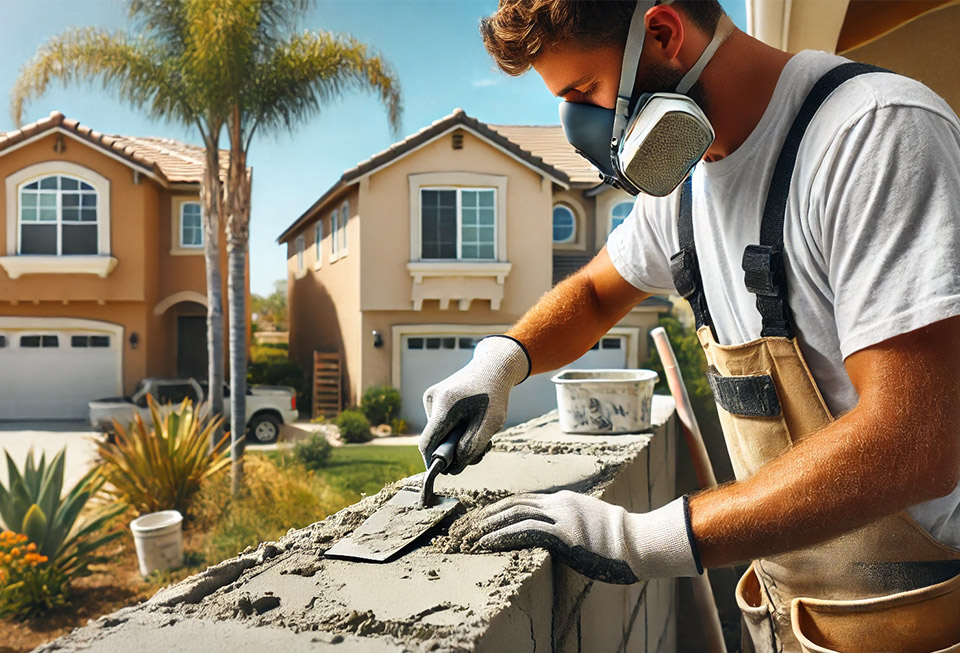
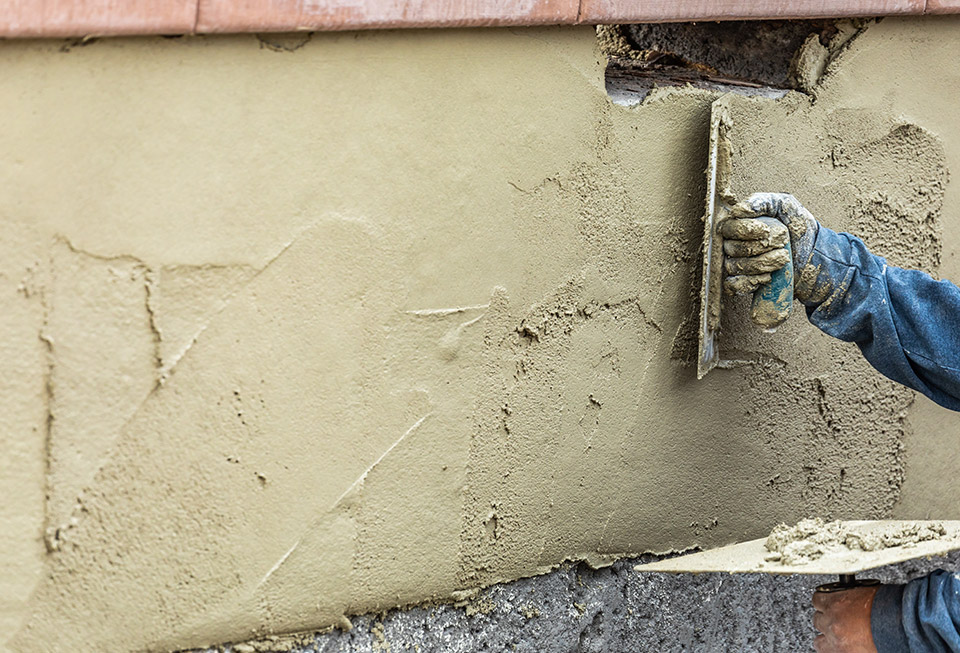
A stucco patch is a surface-level repair. It fills the damaged area and prepares it for painting — it improves the appearance, but it does not rebuild the wall behind it. We mix stucco mix with a little water, get it to consistency with a stir stick or a drill, apply it with a trowel, and feather it out with a sponge so you can’t tell where we patched. Usually one coat.
A stucco repair is much more involved. We cut out the damaged stucco, inspect the underlying building materials, replace or install the waterproof building paper and the metal lath — chicken wire, as we call it, which is what the stucco grabs onto — and rebuild with the traditional three-coat system: scratch, brown, and finish coats, with significant dry time between each. A repair restores the integrity of the wall. A patch is cosmetic. We do both in house, including the full three-coat structural work. What we do not do is re-stucco an entire house. Either way the finish is the same: spot prime with masonry primer, then two coats of 100% acrylic exterior.
Retaining walls: where painting stops being the answer
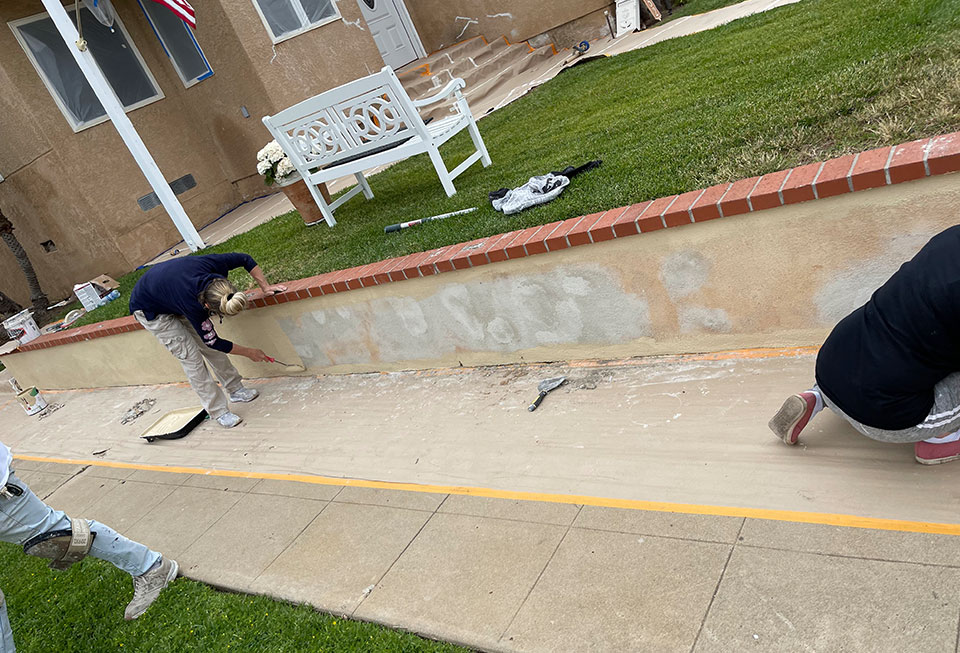
I see this a lot in San Diego — a stucco retaining wall bubbling all over. That is almost always moisture coming from the back side, and it is the clearest example of a problem paint does not solve.
A retaining wall holds back soil, and that soil collects moisture from rain, sprinklers, and morning dew. Without drainage — weep holes, or a French drain pipe inside it — the moisture has nowhere to go. Water is heavy, and it creates hydrostatic pressure. The wall starts to crack. It’ll probably lean. Eventually it can collapse.
That is not painting work, and I’ll tell you so on the estimate. We don’t take on failing retaining walls — you want a retaining wall contractor. A real fix means removing the failing stucco, inspecting for structural issues, installing or restoring drainage — weep holes, or a perforated French drain pipe at the base behind the wall — setting drain rock, adding filter fabric, letting the wall dry, and reapplying the full stucco system. Then we prime and paint the new stucco. Most homeowners don’t, because installing that drain pipe means removing all the soil behind the wall. That’s a Herculean effort, and the cost reflects it.
So most homeowners have us remove the failing stucco, patch it, prime it, and paint it instead — with a clear understanding of what that is. It’s a temporary, cosmetic fix. It might last two years, maybe three, maybe one. It’s genuinely hard to say. We do not warranty it, because we are not fixing the underlying issue: the wall has no drainage. That holds until a retaining wall contractor fixes the waterproofing on the back side. Patching every few years is far cheaper than the drainage fix, but it is not the fix.
Weep holes are not weep screeds
Retaining wall weep holes let water behind soil escape, and their purpose is structural: relieve hydrostatic pressure and keep the wall from failing. They’re individual holes through the face of the wall, near the base, easy to see. A weep screed lets water behind stucco escape and isn’t structural — moisture runs down the building paper, reaches the bottom of the wall, and exits through the screed. It’s continuous rather than separate holes, tucked at the bottom edge, so you have to get underneath and look up.
Should you paint bare stucco?
Yes, and especially here. The objection is that once you paint stucco that’s never been painted, you’re committed. You will occasionally run into bare stucco that’s gone decades with almost no maintenance, but that’s unusual — what I see far more often is the base-of-wall damage above, on bare, unsealed, unprimed stucco.
Paint is a water deterrent. Rain doesn’t soak into a rain jacket the way it would a cotton shirt; it beads up and rolls off, and painted stucco behaves the same way. The two things that damage stucco and wood, which is what most San Diego homes are made of, are the sun and water — ironically, the two things that give us life are the worst things for your house.
The other objection is that stucco needs to breathe and paint traps moisture. The real concern there is a low-quality, non-breathable coating, which can trap moisture and lead to peeling and efflorescence — a cheap-paint problem. Any respectable company is using a premium acrylic masonry paint.
Match the technique to your texture, not to a rule of thumb
This is where most advice falls down. “Spray it” and “roll it” are both wrong as universal answers. What we do depends entirely on the texture on your wall, and San Diego has all of them.
- Smooth or Santa Barbara finish — spray only. We don’t back roll, because it risks stipple or roller marks, and that ruins the smooth appearance you paid for.
- Fine sand finish — spray only. Very common on newer San Diego homes. Aggressive rolling can leave texture that wasn’t there before.
- Medium sand — spray, with a light back roll just on the stucco patches and areas that are particularly porous.
- Spanish lace — spray and back roll. Very common here. There are a lot of small nooks and crannies under the lace, and sprayed paint can bridge right over them, especially thicker paint. The back roll works it in for adhesion.
- Skip trowel — spray and back roll. The raised islands create shadow areas only a sprayer can reach.
- Dash, heavy knockdown, cat face — spray and back roll, so we don’t miss any of the valleys.
On most San Diego textures, a roller by itself isn’t how paint gets into the wall. The sprayer reaches the texture; the roller works it in, and only where the texture calls for it. Back rolling is only necessary on heavy texture — on a smooth finish it hurts more than it helps.
What a proper stucco paint job involves
- Thorough power wash to take off dirt, chalk, cobwebs, and mildew. Then let it dry — at least 48 hours.
- Stucco patch the damage: cracks, bubbling stucco, missing chunks.
- Scrape any loose paint.
- Prime. Spot prime with masonry primer. If the stucco has never been painted, that becomes a full coat over the whole house — dry time per the can, usually around four hours.
- Mask everything you don’t want overspray or splatter on.
- Spray with roughly a 515 to 517 tip and just enough pressure for a clean fan pattern — not so much that it lays on too much paint at once or throws overspray into the neighbor’s yard. Hold the gun 10 inches to a foot off the wall, perpendicular.
- Overlap about 50% on each pass, and cross-hatch on heavy textures: top to bottom, then left to right and right to left.
- Two full finish coats, with the first dried completely — at least two hours, more if needed.
Cross-hatching is about viewing angles: going both directions gets paint into all the nooks and crannies, so whether you’re looking down from inside, up from the sidewalk, or in from either side, the area is fully covered. Spray a heavily textured wall one direction only and you’ll see the spots you missed. But cross-hatching is not two coats. Up and down, then left and right, is one coat applied properly.
Primer, paint, and sheen
Primer comes down to one question: has this stucco ever been painted? If it’s raw stucco, you need a separate coat of masonry primer, not just any primer. The two we like best from our own experience are Loxon Concrete and Masonry Primer from Sherwin-Williams and Ultra-Grip Premium from Dunn-Edwards — both adhere well to masonry and both are breathable. Priming also saves money, because raw stucco drinks paint: skip it and your total at the paint store comes out higher than if you’d primed first.
For exterior stucco in San Diego we prefer Dunn-Edwards Evershield and Sherwin-Williams Duration, based on what we’ve watched hold up on our own jobs. Evershield is formulated for hot, sunny climates like ours: breathable, durable under harsh UV, good at resisting fading, and not quite as thick as Duration — which is a point in its favor on stucco. Duration is a close runner-up: thicker, so it hides imperfections well, but a bit less breathable. We use Evershield on stucco and Duration more on wood homes.
On sheen, part of the answer is taste. The higher the sheen, the more durable the coating and the more it acts as a vapor barrier — the same reason semi-gloss gets recommended in bathrooms. But the body of the house is maybe 85% of what you see, and people fine with satin trim rarely want the whole house shining. Flat hides imperfections where sheen highlights them, doesn’t throw glare in direct sun, and gives you the classic Southern California look. Our standard recommendation is flat, because with a high-end product you still get water shedding at a flat sheen — with a low-end paint, sheen matters much more.
How long it lasts, and what that depends on
It depends, and the conditions are the whole answer. If the wall is power washed and left to dry at least 48 hours, bare stucco gets a full coat of premium masonry primer with proper dry time, and you follow with two coats of a higher-end paint like Duration or Evershield, sprayed and back rolled where the texture calls for it, you should get 12 to 15 years.
The same holds across the rest of the house. If the last crew did everything right — thorough power wash, scraped and sanded the chipping and peeling, primed bare wood and anywhere they sanded, caulked cracks, replaced rotten wood, patched failing stucco, and two coats of 100% acrylic in the better-to-best grade — you are in that same 12 to 15 year band. Top notch prep work combined with top-of-the-line materials is what buys it. What most San Diego houses actually get is an average job from an average painting contractor using low- to mid-grade paint, and that typically only lasts six to seven years. The spread between six and fifteen is prep and paint grade, and almost nothing else.
What a stucco repair and painting estimate should explain
Ask whether the price covers a surface patch or opening and rebuilding the damaged area. Then ask what gets painted: just the repaired area, the surrounding wall, or a larger exterior repaint. Those are different scopes. A gray repair patch is not a finished paint job, and repairing the face of a wall is not the same as correcting water coming from behind it.
For general painting-bid comparisons, use my guide to comparing exterior house painting bids. On stucco, these are the questions I would start with:
- Is my damage a patch or a repair? A contractor who can’t tell you which you need, and why, is guessing.
- What technique for my texture? If the answer is the same whether you have Santa Barbara or Spanish lace, that’s a problem.
- Is bare stucco getting a full coat of masonry primer? Not just any primer.
- Does “two coats” mean two separate finish coats, with dry time between them?
- Is there a moisture source to fix first? If the honest answer is a drainage problem, painting is buying time, not a solution.
Frequently asked questions
Can I paint my stucco house with a roller?
It depends on your texture. On smooth, Santa Barbara, and fine sand finishes we spray only, because rolling leaves stipple and marks that weren’t there before. On Spanish lace, skip trowel, dash, heavy knockdown, and cat face we spray and then back roll.
Should stucco be painted flat or satin?
Our standard recommendation is flat, because it gives the most uniform appearance and minimizes visible repairs. A sheen is more durable and more water resistant, but it highlights imperfections and glares in direct sun. If you want the house easy to hose off, a velvet or eggshell is a middle ground.
Will painting fix my bubbling stucco retaining wall?
No. Bubbling on a retaining wall is almost always moisture pushing from the back side — a drainage problem, not a paint problem. We can remove the failing stucco, patch, prime, and paint it, and it will look considerably better, but that’s cosmetic and temporary, it isn’t warrantied, and how long it holds is unpredictable. The actual fix is a retaining wall contractor addressing the drainage.
What is the difference between stucco patching and a full stucco repair?
A patch fills and feathers surface damage without rebuilding the wall behind it. A full repair removes damaged stucco, checks the underlying materials, replaces or installs building paper and metal lath as needed, and rebuilds the scratch, brown, and finish coats. Both need masonry primer and paint afterward; a full repair also needs drying time between its stucco coats.
Can I paint over bubbling stucco or white powder?
Do not treat either as just a color problem. Bubbling or loose stucco needs assessment, and white powder may be efflorescence from moisture moving through masonry. Find and address the moisture source, let the wall dry, remove deposits, and repair damaged stucco before primer and paint. If moisture continues entering, the damage or deposits can return.