


Cost vs value: Finding the best home painting company is priceless
December 23, 2021Kitchen Cabinet Painting: What Questions Should You Be Asking
January 11, 2022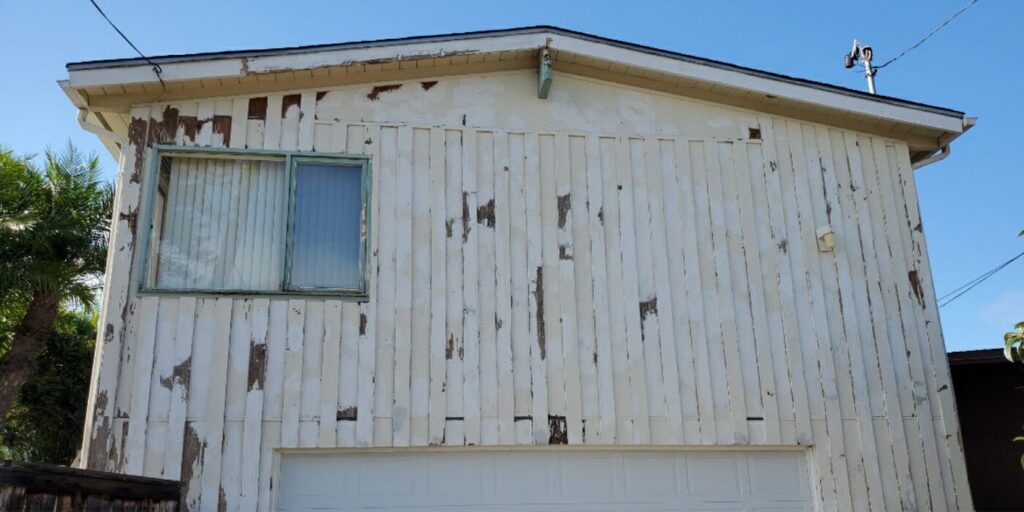
A San Diego home needs exterior-paint attention when the coating leaves powder on your hand, fades unevenly, cracks, peels, or forms an alligator-skin pattern. Soft wood and bubbling or missing stucco are different warnings: those surfaces may need repair—or a moisture problem may need to be corrected—before new paint can do its job.
I am Justin Brown, founder and lead estimator at J Brown Painting. When I inspect an exterior, I do not start with the age of the last paint job. I start with what the coating and the surface are telling us. The same-looking blemish can lead to a touch-up, a full repaint, a wood repair, or a stucco and drainage conversation.
The quick exterior-paint check
Walk around the house in daylight and look closely at the sunniest walls, fascia and eaves, window and door trim, garage door, lower stucco, and joints around openings. These six conditions deserve attention:
- Chalking: a powdery residue transfers to your hand or a dark cloth.
- Fading: the color or sheen has changed, especially on the most exposed elevations.
- Cracking, flaking, or alligatoring: the coating has split and is releasing from the surface.
- Soft or exposed wood: peeling paint has revealed a substrate that may need repair.
- Bubbling or missing stucco: the finish may be failing because moisture is moving through or behind it.
- Open caulk joints: gaps around trim and penetrations need to be evaluated and included in the prep scope.
One isolated defect does not automatically mean the entire house needs paint. Multiple symptoms across several elevations usually point toward a larger maintenance cycle. The key is to separate a coating problem from a substrate or moisture problem before deciding the scope.
1. Chalking: color comes off on your hand
Rub your hand or a dark cloth across a painted fascia board, garage door, or stucco wall. If a fine powder transfers to it, that is chalking. Exterior coatings weather over time, and sunlight and moisture gradually break down the resin that holds the pigment in the paint film.
Light chalking is not the same as peeling. The surface has to be cleaned and allowed to dry, then checked again. Heavy residue cannot simply be sealed under a new coat; if the chalk is not removed or properly stabilized, the next coating may be trying to bond to powder instead of a sound surface.
This is why an estimate should say more than “power wash and paint.” The painter should evaluate how much chalk is present, what cleaning and surface preparation are required, and whether bare or porous areas need primer.
2. Fading: compare color loss with coating failure
San Diego sun can make one side of a house look older than another. A south- or west-facing wall may lose color and gloss while a shaded wall still looks relatively fresh. Fading alone can be an appearance issue, so it is not enough to diagnose the coating from the curb.
Check the faded area for chalking, hairline cracking, loss of adhesion, exposed substrate, and failed caulk. If the color changed but the film is still sound, the reason to repaint may be mainly cosmetic. If fading appears with heavy chalk, cracking, or peeling, the coating is giving stronger evidence that it has reached the end of its useful service.
A professional inspection should also distinguish true color fade from dirt, sprinkler deposits, mildew, or another surface contaminant. Cleaning a test area can prevent the wrong conclusion.
3. Peeling, flaking, and alligatoring: do not paint over the edges
Peeling and flaking mean the existing coating has lost adhesion somewhere in the system. Alligatoring is the more advanced cracked pattern that looks like reptile skin. The cause may involve age, poor preparation, incompatible coatings, excessive film buildup, or moisture. The repair begins by finding the boundary between loose paint and sound paint.
The loose coating needs to be scraped or sanded away, the remaining edges feathered smooth, and exposed material primed as the surface requires. A quick coat over loose edges may look better temporarily, but it leaves the failed layer underneath.

When failure is widespread across a wall or several elevations, spot touch-ups become inefficient and visibly patchy. That is usually the point to price a full preparation-and-repaint scope rather than a collection of small repairs.
4. Exposed or soft wood: repair comes before primer
Peeling paint on fascia, eaves, siding, or trim can expose wood that is still sound—or reveal wood that has already lost strength. Gently press an already damaged spot with a screwdriver. Firm wood may only need the failed coating removed, sanding, and spot priming. If the tool enters easily, the area is soft, the decay runs deep, or the board will not hold a fastener, paint is not the repair.
Small localized defects may be candidates for filler or a partial splice. Widespread or deep decay calls for replacement. Our guide to wood repair versus replacement explains that decision, and our San Diego wood-repair service shows how it fits into painting preparation.

5. Bubbling or missing stucco: look for the moisture source
Bubbling stucco is not automatically a request for another coat of paint. On lower walls and retaining walls, moisture may be moving from the soil or from behind the wall. On a retaining wall without adequate drainage, water pressure can keep damaging a cosmetic patch from the back side.
A painter can remove failed material, patch appropriate areas, prime, and paint, but paint cannot correct failed drainage or a structural wall problem. A leaning or seriously cracked retaining wall, or a wall with an unresolved drainage problem, needs the appropriate retaining-wall or waterproofing specialist first. Painting over active failure only hides the evidence for a while.
Ordinary exterior stucco damage still needs the right repair sequence before coating. J Brown Painting handles localized patching and full three-coat stucco repair where appropriate, but not re-stuccoing an entire house. See our stucco repair service in San Diego for the difference between cosmetic and structural work.
6. Cracked caulk: a prep item, not a diagnosis by itself
Caulk around selected trim joints and penetrations loses elasticity over time and may split away from one side. Open joints can admit water, but cracked caulk by itself does not prove that every painted surface has failed.
During an estimate, identify which joints should be caulked and which should remain open for drainage. The scope should name removal of loose caulk, preparation of the joint, and replacement with a compatible paintable product where appropriate. “Caulk as needed” is difficult to compare between bids because it does not say where or how much work is included.
Touch up, repair, or repaint the full exterior?
A localized touch-up makes sense when the surrounding coating is sound, the original color and sheen can be matched, and the defect is truly isolated. Even then, sunlight and weathering may make a new patch visible against older paint.
A full repaint is the better discussion when chalking, fading, cracking, or peeling appears across several areas; when preparation will leave many primed patches; or when the owner wants consistent color and protection across the whole exterior. Wood or stucco repair should be written as a separate step before the coating work, not hidden inside a vague paint line item.
Ask the estimator to classify each visible issue:
- Cleaning only — dirt or residue, with a sound coating underneath.
- Localized coating repair — one limited failure surrounded by sound paint.
- Substrate repair — damaged wood or stucco must be repaired before coating.
- Moisture or structural referral — the cause is outside a painter’s scope.
- Full repaint — failure or weathering is broad enough that patching is no longer the sensible scope.
How often should a San Diego exterior be repainted?
There is no useful answer without knowing how the last job was prepared and what materials were applied. In our experience, an average exterior job from an average contractor using low- to mid-grade paint often leads to repainting in roughly six to seven years.
With thorough washing, removal of loose paint, sanding, primer on bare and repaired areas, necessary caulking, wood and stucco repairs, and two coats of premium 100% acrylic exterior paint, a strong exterior system can reach roughly 12 to 15 years. Those are planning ranges from our field experience, not guarantees. Exposure, moisture, sprinklers, vegetation, substrate condition, color, and maintenance all change the result.
That is why I recommend inspecting the surface instead of repainting only because a calendar says so. The coating tells you more than its birthday.
What a useful exterior estimate should include
A good estimate turns the diagnosis into a written scope. It should identify the surfaces being painted, the known repair locations, the washing and preparation, where primer is included, the number of finish coats, the paint line and sheen, masking and protection, exclusions, and what happens if preparation exposes additional damage.
If one bid says “paint exterior” and another lists scraping, sanding, spot priming, stucco patching, wood repair, caulking, and two finish coats, those bids are not pricing the same job. Our residential exterior painting service explains the full preparation sequence we use.
Exterior paint warning signs FAQ
What is chalking on exterior paint?
Chalking is a fine powder that forms on the coating as it weathers. Rub the surface with your hand or a dark cloth; if pigment-like residue transfers, the surface is chalking. The residue must be removed and the underlying coating evaluated before repainting so the new paint bonds to a sound surface rather than loose powder.
Can faded exterior paint still protect a house?
Sometimes. Color fade can occur before the coating loses adhesion, so fading alone does not prove complete failure. Check for chalking, cracking, peeling, exposed material, and open joints. If several of those appear together, the case for repainting is much stronger.
Can peeling exterior paint be touched up?
A small isolated area can sometimes be repaired if the surrounding coating and substrate are sound. Loose paint still has to be removed, edges sanded, and exposed material primed. Widespread peeling across a wall or several elevations usually calls for a larger preparation-and-repaint scope.
Does bubbling stucco need paint or repair?
It needs a cause-first inspection. Localized failed stucco may be patched, primed, and painted. Bubbling at the base of a wall or on a retaining wall can point to moisture or drainage from behind the surface. Paint will not correct that underlying condition, and structural or drainage problems belong with the appropriate specialist.
How often should I repaint my house exterior in San Diego?
Our practical range is roughly six to seven years for an average job using low- to mid-grade paint, versus roughly 12 to 15 years for a properly prepared exterior with necessary repairs and two coats of premium 100% acrylic paint. Conditions and maintenance vary, so inspect the coating and substrate instead of relying on age alone.
Get the diagnosis before choosing the paint
The goal is not to sell a full repaint for every blemish. It is to identify whether the house needs cleaning, a localized coating repair, wood or stucco work, correction of a moisture source, or a complete exterior system.
If you see chalking, peeling, soft wood, or bubbling stucco, request a written exterior estimate. We will inspect the surfaces, separate repairs from paint, and define the preparation before choosing the finish coats.


