What Photos Should You Send for an Exterior Painting Estimate?
November 16, 2026After a Stucco Patch, Should You Repaint the Whole Wall?
November 16, 2026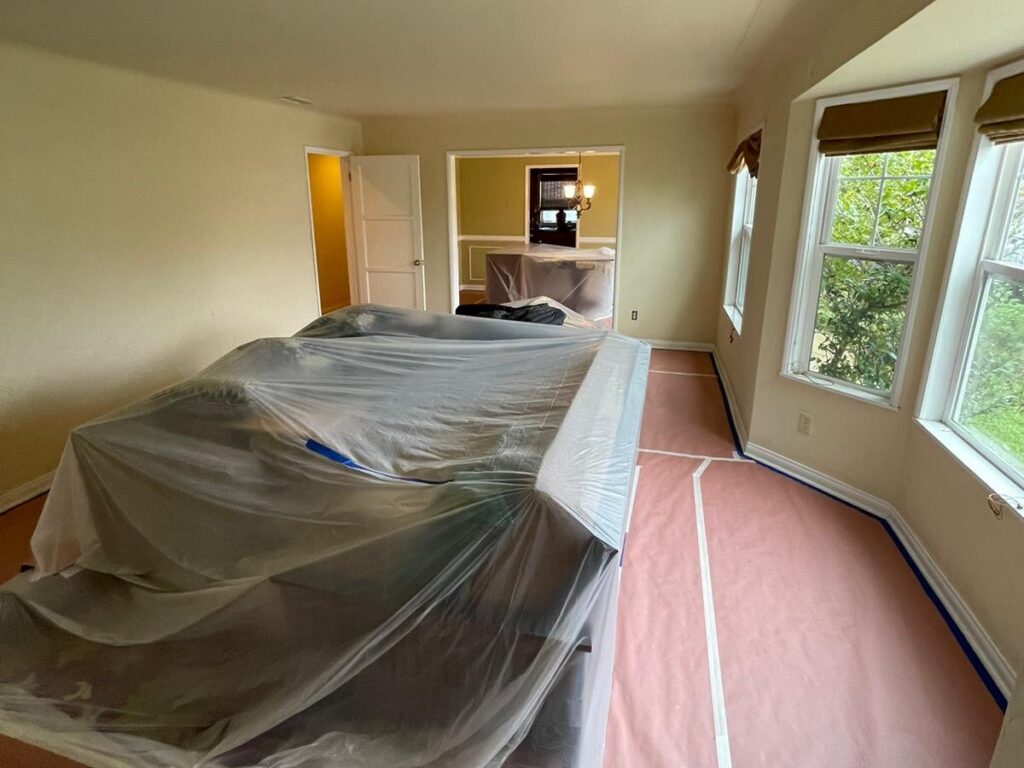
Furniture and flooring protected in one room before painting.
Start with the room you can’t easily give up. Maybe you need one bedroom at night, or the home office is your only place to take calls. When I walk an occupied home, this is one of the first things I want to know. Tell us which rooms you need and when. Then we can talk through a sequence that works with the scope, the layout and the paint’s drying time.
Make a room-by-room access list
Write each room on its own line. Next to it, record what is being painted and when you need the room back. If the hallway is the only route to the bedrooms, flag it as shared access. Do the same for a stairway or a doorway used by children or pets. List the doors, casings and baseboards you want painted, because access can depend on when that trim is ready to use as much as when the walls are finished.
At the walkthrough, ask which rooms can realistically be grouped. You might hand over one bedroom early and leave a second as a backup. In an open-plan space, the living room, dining room and hall might share walls or sight lines. Discuss how far the work extends so everyone agrees where that part of the project ends.
Keep the paint sequence clear inside each room
When the estimate includes all of those surfaces, we usually paint ceilings first, then walls, doors and baseboards. Decide which rooms the crew should start in before work begins. If a room’s ceiling is outside the scope, we can adjust the work in that room. Discuss which furniture you can move and what the crew should handle. That affects where protection goes and which routes can stay clear.
Ask what “usable again” means before the crew moves on. Being able to walk into a room, pushing furniture against a wall, and closing a freshly painted door all have different implications. The paint, the conditions in the room and the surfaces included affect that handoff. Ask the crew for the timing on your job.
Bring a simple schedule to your estimate
| Space | What the estimator needs to know |
|---|---|
| Primary bedroom | Which nights you need to use it and whether an alternate room is available. |
| Home office | Your calls and any equipment that needs to stay in place. |
| Hall and stairs | When the household needs the only route through. |
| Shared living area | Which surfaces and connected rooms are in scope. |
Questions about living at home during interior painting
Can we leave one bedroom available while the others are painted?
Tell us which bedroom you need and on what nights. We can discuss keeping it out of the first phase, depending on the surfaces in scope and how the crew needs to move through the house.
Can we use the hallway while the adjoining rooms are being painted?
Flag the hallway if it is your only route to a bedroom or bathroom. Ask the crew when protection or work on walls and trim will affect access. Agree on the timing at the walkthrough.
When can furniture go back against the walls?
Ask before moving anything back. The paint may feel dry before it is ready for furniture to touch it. The crew can give you guidance based on the coating and conditions in that room.
If you’re deciding what to move before work starts, use the interior painting preparation guide. For the room sequence and a line-item quote, request an interior painting estimate and share the rooms and times you need to keep available.